The HSE Application Is 44 Pages Long. The Financial Assessment Runs on Formulas. And Private Fees Are Burning €1,000+ Per Week While You Wait.
Your parent needs nursing home care. The hospital discharge team is asking for a plan. You've heard the words "Fair Deal" but when you sit down with the actual application, you discover a system built for accountants and solicitors — not for families in crisis.
The Care Needs Assessment can refuse your application outright. The financial assessment uses different rates for singles and couples, with exemptions that change depending on whether the property is occupied. The Nursing Home Loan requires every co-owner's signature on a Charging Order. And if your parent has lost the capacity to sign, the entire process stops until you get a court order that most families don't know exists.
Meanwhile, you're paying full private rates — typically €1,000 to €1,500 per week — from the day your parent enters a nursing home until the day the HSE formally approves the application. That gap averages four to six weeks. The families who submit a complete, error-free application on the first attempt close the gap fastest. The ones who submit incomplete paperwork wait months.
The Fair Deal Filing System — Every Step, Every Form, Every Calculation in One Place
This is not a pamphlet that tells you Fair Deal exists. It is the full administrative framework for getting through the HSE process: the clinical assessment that unlocks state funding, the financial formulas that determine what your parent pays, the asset protections most families don't realise they qualify for, and the planning tools that keep the application on track.
The guide is built around the principle that the HSE's own rules protect families far more than most people realise — but only if you know the rules exist and apply them correctly. The three-year cap on the family home. The 2024 rental income exemption. Farm and business relief under the 2021 Amendment Act. These are not obscure loopholes. They are statutory provisions that go unused because families never hear about them until after the financial assessment is complete.
What's Inside
- Line-by-line application guidance — what to write in Parts 1 through 6 of the HSE application form, which supporting documents to attach, and how to avoid the common errors that trigger processing delays
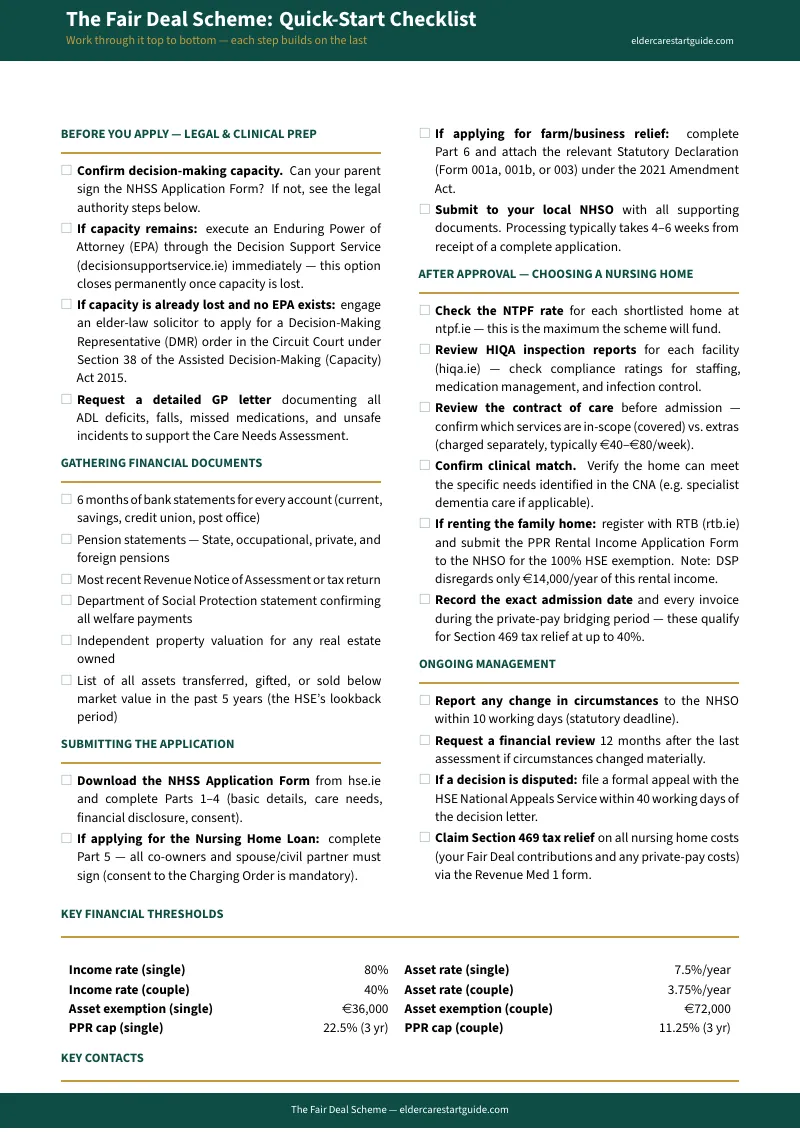
- The full financial assessment formula — 80% of income and 7.5% of assets for singles, halved for couples, with the €36,000/€72,000 asset disregard applied step by step through two worked examples using realistic Irish figures
- Three-year cap explained — how the principal private residence is protected, when the cap clock starts, what happens if you sell, and the couple-specific rules that halve the assessment
- Rental income exemption (2024) — how to retain 100% of rental income from the family home under Fair Deal, including the RTB registration, minimum housing standards, and the capacity trap if no EPA was registered
- The Nursing Home Loan — deferring property-based contributions through a Charging Order, the repayment timeline (12 months after death, 6 months after sale), and how probate delays interact with Revenue's interest-free window
- Farm and business relief — the 2021 Amendment Act's successor rules, the statutory declarations required, the six-year commitment, and the disqualification traps that catch families who file without legal preparation
- Legal authority when capacity is lost — Enduring Power of Attorney through the Decision Support Service, the Circuit Court route to a Decision-Making Representative, and why the EPA window closes permanently once capacity is gone
- Contract of care audit — how to compare nursing homes using NTPF rates and HIQA inspections, identifying unfair grey-listed terms, and challenging "optional extras" that inflate costs by €40–€80 per week
- Appeals and tax relief — the 40-working-day appeal window, grounds for financial review, Ombudsman escalation, and claiming tax relief at your marginal rate (up to 40%) on private fees paid during the HSE processing gap
- 7 printable planning tools — Application Timeline Planner, Document Gathering Checklist, Weekly Contribution Calculator, Nursing Home Comparison Worksheet, Financial Assessment Review Tracker, Estate Administration Checklist, and Agency Communication Log — each a standalone PDF you can print and fill in as you work through the process
Who This Is For
This guide is for adult children navigating a parent's move into long-term residential care in Ireland. Whether you're planning ahead after an early-stage diagnosis or organising under discharge pressure from a hospital stay, the guide gives you the administrative framework to submit a complete application, understand the financial assessment, and protect your family's assets within the rules the HSE itself provides.
It covers standard applications — the cases where a family needs an organising framework more than a solicitor. For complex estates, contested capacity, or multi-property assessments, you will still need professional advice. But the guide ensures you arrive at that meeting with your documents organised, your figures calculated, and your questions targeted — saving hours of billable time.
Why Not Just Use the Free Government Pages?
Citizens Information and the HSE website describe the rules of the scheme accurately. What they don't provide is an organising system. They tell you the financial assessment uses 80% of income — but they don't walk you through the calculation with your family's actual numbers. They mention the three-year cap — but they don't explain how it interacts with the rental exemption, the Nursing Home Loan, and a property sale. They list the documents you need — but they don't give you a tracker that maps which office to contact for each one, or a timeline that shows which tasks can run in parallel.
The gap between knowing the rules and actually applying them correctly is where applications stall, funding gets delayed, and families overpay. This guide fills that gap.
Specialist consultants like Fair Deal Advice or Fair Deal 360 charge €195–€1,495 for the same knowledge, delivered in a consultation. This guide puts that knowledge in your hands for a fraction of the cost — and you can refer back to it at every stage of the process.
Satisfaction Guarantee
If the guide doesn't help you navigate the Fair Deal process more clearly, email hello@eldercarestartguide.com and we'll refund your purchase. No time limit, no questions.
Get Started
Download the free Quick-Start Checklist to see the 23 critical steps at a glance. When you're ready for the full application framework — worked financial examples, asset protection strategies, planning tools, and 49 pages of step-by-step guidance — get the complete Fair Deal Filing System for .